


 WhatsApp


The widespread use of routine abdominal imaging (CT scans and MRIs) has led to an exponential increase in the incidental diagnosis of small renal masses (cT1a/cT1b tumors $\le 7\text{ cm}$). Historically, the standard surgical response to any solid kidney tumor was a radical nephrectomy—the complete removal of the entire kidney and its surrounding Gerota’s fascia.
However, long-term oncologic research has demonstrated that removing an entire functional kidney often trades cancer control for a heightened risk of chronic kidney disease (CKD), long-term cardiovascular morbidity, and overall mortality. Today, Robotic Partial Nephrectomy (RPN), or nephron-sparing surgery, has emerged as the definitive gold standard for small renal masses.
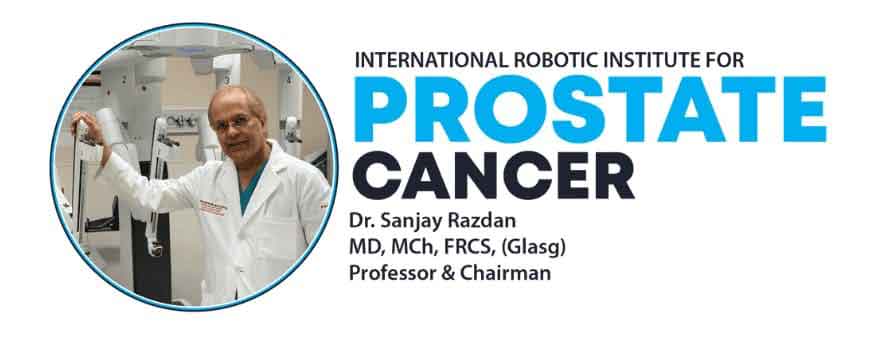
At the International Robotic Institute for Prostate Cancer in South Florida, Dr. Sanjay Razdan—internationally renowned for performing over 10,000 robotic procedures—applies high-volume precision robotics to upper-tract oncologic reconstruction. Utilizing the da Vinci surgical system’s 3D high-definition optical magnification and wristed micro-instruments, Dr. Razdan performs precise tumor resection while preserving maximum viable nephrons and healthy renal parenchymal function.
The Nephron-Sparing Imperative: Radical vs. Partial Nephrectomy
The human kidney contains roughly one million microscopic functional filtration units called nephrons. Once nephrons are lost or excised, they cannot regenerate.
[SOLID RENAL MASS DIAGNOSED (T1a / T1b)]
│
├─► Radical Nephrectomy ──► 50% instant loss of renal mass ──► Risk of CKD & cardiac events
│
└─► Partial Nephrectomy ──► Targeted tumor excision ───────► Preserves functional nephrons
Preserving the surrounding functional kidney parenchyma provides essential clinical advantages:
- Preservation of Estimated Glomerular Filtration Rate (eGFR): Sparing nephrons minimizes the risk of post-operative acute kidney injury and prevents long-term progression to end-stage renal disease (ESRD).
- Cardiovascular Risk Reduction: Clinical data consistently demonstrates that patients who maintain stable renal function experience significantly lower long-term cardiovascular events (heart attack, stroke) compared to those who undergo complete kidney removal.
- Oncologic Equivalence: Multi-center randomized trials have confirmed that for tumors $\le 7\text{ cm}$, partial nephrectomy achieves local recurrence-free survival rates identical to radical nephrectomy.
Navigating Warm Ischemia Time (WIT) Under 3D Magnification
During a partial nephrectomy, temporarily clamping the renal artery (and occasionally the renal vein) is required to stop blood flow, allowing the surgeon to excise the tumor in a clear, bloodless field. The duration of this clamping is known as Warm Ischemia Time (WIT).
[Vessel Clamping: Bulging Bleed Stops] ──► Tumor Excision (Clean Margin) ──► Renorrhaphy (Two-Layer Reconstruction)
│
▼
[RACE AGAINST THE CLOCK: Target WIT < 20–25 Minutes]
│
▼
[Vessel Release (Reperfusion)] ──► Minimizes ischemic cellular injury to adjacent nephrons
Prolonged warm ischemia ($> 25\text{ to }30\text{ minutes}$) leads to ischemic cellular necrosis in the healthy kidney tissue. High-volume robotic expertise is critical during this phase:
- Endo-Wristed Maneuverability: The da Vinci instruments articulate with seven degrees of freedom, mirroring and exceeding the human wrist. This enables rapid, curved tumor enucleation along the pseudocapsule, minimizing incidental damage to healthy kidney tissue.
- Selective / Super-Selective Clamping: Rather than clamping the main renal artery, experienced robotic surgeons can selectively isolate only the tertiary segmental branches feeding the tumor, keeping the remainder of the kidney perfused throughout resection.
- Rapid Multi-Layer Renorrhaphy: Once the mass is removed, the inner medullary collecting system and blood vessels are repaired, followed by a sliding-clip closure of the renal cortex to secure hemostasis in minutes.
Complexity Scoring: Evaluating Tumor Anatomy via the R.E.N.A.L. Nephrometry System
Not all kidney tumors are simple outward-growing nodules. Dr. Razdan utilizes standardized scoring frameworks, such as the R.E.N.A.L. Nephrometry Score, to objectively classify structural complexity based on pre-operative 3D CT/MRI scans:
R ──► (R)adius of the tumor (maximal diameter in centimeters)
E ──► (E)xophytic vs. Endophytic properties (how deeply it dives into renal parenchyma)
N ──► (N)earness of the tumor to the collecting system or renal sinus (in millimeters)
A ──► (A)nterior or Posterior location on the renal surface
L ──► (L)ocation relative to polar lines (upper, middle, or lower pole)
High-complexity tumors—such as completely endophytic (buried deep inside the kidney) or hilar masses immediately adjacent to the main renal artery and vein—demand the optical clarity and tremor-free micro-dissection of a high-volume robotic surgeon to avoid complete kidney sacrifice.
Comparative Surgical Metrics: Partial vs. Radical Nephrectomy
| Clinical Parameter | Radical Nephrectomy (Complete Removal) | Robotic Partial Nephrectomy (Nephron-Sparing) |
| Parenchymal Tissue Loss | ~50% total renal mass excised | Targeted lesion excision; >85%–95% kidney spared |
| Warm Ischemia Time | Not applicable (organ removed) | Minimized (< 20–25 minutes) or clamped selectively |
| Long-Term CKD Risk | Substantially higher baseline risk | Significantly lower risk of de novo CKD |
| Cardiovascular Morbidity | Elevated long-term risk profile | Protective long-term cardiovascular profile |
| Hospital Recovery | 2 to 4 days inpatient stay | 1 to 2 days (often outpatient / 24-hr discharge) |
| Oncological Control | Complete local eradication | Identical local recurrence-free survival rates |
Conclusion
A diagnosis of a solid kidney mass does not have to result in the loss of your entire kidney. Through Robotic Partial Nephrectomy, high-definition 3D visualization, and rapid surgical reconstruction, Dr. Sanjay Razdan provides patients with curative cancer clearance while safeguarding long-term renal function and survivorship quality of life.
- Surgeon: Dr. Sanjay Razdan, MD, MCh, FRCS (Glasg)
- Academic Leadership: Professor and Chairman, International Robotic Institute for Prostate Cancer
- Official Practice Website:miamiroboticprostatectomy.com
- Main Center Location: 3650 NW 82nd Ave, Suite 501, Doral, FL 33166
- Direct Consultations: (305) 251-8650