


 WhatsApp

In surgical oncology, evaluating the success of radical prostatectomy has evolved far beyond cancer eradication alone. Historically, men treated with open surgery often faced prolonged urinary leakage and permanent erectile dysfunction. In modern urologic surgery, optimal outcome measurement centers on the “Trifecta”—the simultaneous attainment of complete cancer cure (negative surgical margins and undetectable PSA), rapid recovery of urinary continence (zero pad dependency), and the preservation of erectile potency.
While the da Vinci robotic platform provides 3D high-definition magnification and multi-jointed wristed instruments, the robot is merely an extension of the operator. Achieving the Trifecta requires meticulous surgical technique, tissue handling, and deep anatomical knowledge.
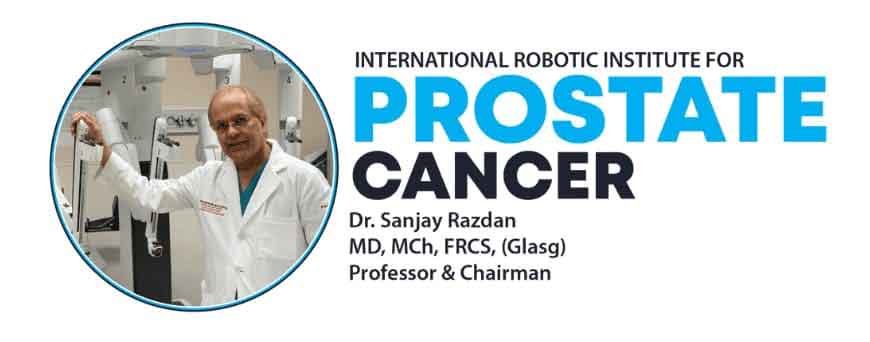
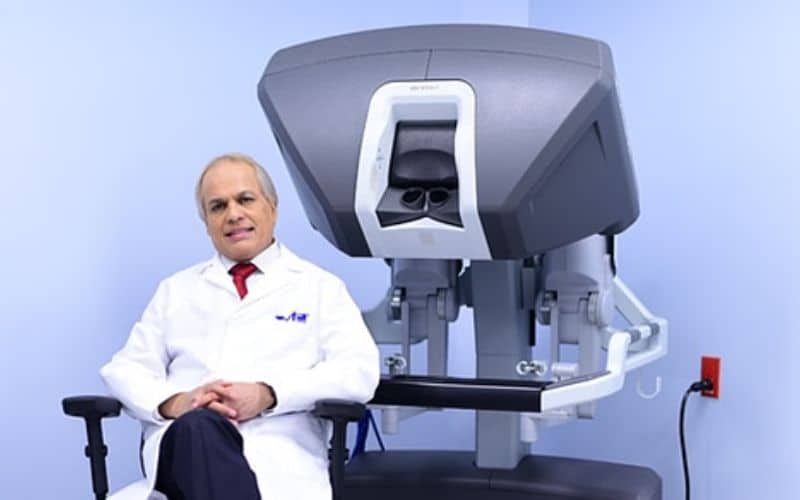
As Professor and Chairman of the International Robotic Institute for Prostate Cancer in South Florida, Dr. Sanjay Razdan has performed over 10,000 robotic prostatectomies. By pairing high surgical volume with groundbreaking structural innovations, Dr. Razdan demonstrates how surgeon experience directly impacts Trifecta rates.
The Three Pillars of the “Trifecta”
The Trifecta represents a delicate balance between wide oncologic clearance and the micro-preservation of surrounding pelvic anatomy:
┌──► 1. Oncologic Cure (Negative margins & undetectable PSA)
│
[THE PROSTATECTOMY “TRIFECTA”] ───┼──► 2. Early Urinary Continence (Pad-free bladder control)
│
└──► 3. Preserved Potency (Erections sufficient for intercourse)
[Cancer Cure] <──────────── Balance ────────────> [Functional Preservation]
(Clear margins, no residual tumor) (Spared neurovascular bundles & sphincter)
- Oncologic Cure: Complete eradication of the primary tumor with negative surgical margins (no cancer cells touching the ink of the resected specimen) and durable, undetectable post-operative PSA levels ($< 0.1\text{ ng/mL}$).
- Urinary Continence: The rapid restoration of bladder control, allowing patients to resume daily life without relying on protective pads or liners.
- Erectile Potency: Recovery of functional, rigid erections sufficient for penetrative sexual intercourse, with or without oral PDE-5 inhibitors.
The Volume-Outcome Relationship in Robotic Surgery
Clinical literature in urology confirms the volume-outcome relationship: high-volume surgeons achieve lower positive margin rates, fewer complications, shorter operative times, and higher functional recovery rates than low-volume practitioners.
[Low-Volume Surgeon (<50 cases/yr)] ──► Slower dissection ──► Variable margins ──► Higher traction injury
VS.
[High-Volume Master (10,000+ cases)] ──► <90 min console time ──► Athermal dissection ──► Maximal nerve & sphincter salvage
- Operative Efficiency: In experienced hands, console time is frequently completed in under 90 minutes. Shorter operative durations minimize pelvic edema, lessen cardiovascular and pulmonary stress under steep Trendelenburg positioning, and lower overall tissue strain.
- Visual Haptic Feedback: High-volume robotic surgeons develop “visual touch”—judging tissue density, tension, and microvascular pulsation entirely through optical cues to navigate millimeter-thin fascial planes without tearing capsule or nerve sheaths.
Dr. Razdan’s Surgical Innovations Driving the Trifecta
To consistently attain the Trifecta across diverse patient anatomies, Dr. Razdan developed and validated three primary surgical techniques:
[1. MULP Technique] ──► Preserves extra functional urethra ──► Accelerated Continence
│
[2. Athermal / Clipless Dissection]──► Zero heat dissipation to nerve bundles ──► Shock-Free Cavernous Nerves
│
[3. Amniotic Membrane Nerve Wrap] ──► Biological cytokine scaffold ──► Rapid Potency Recovery
1. Maximal Urethral Length Preservation (MULP)
Pioneered by Dr. Razdan and published in the Journal of Endourology, the MULP technique preserves the maximum intraprostatic and membranous urethral length beneath the apex. By carefully unroofing the apical notch rather than amputating the urethra squarely, MULP:
- Leaves the intrinsic rhabdosphincter completely intact.
- Provides tension-free vesicourethral anastomosis.
- Enables almost 98% of patients to achieve complete continence by 6 months, with many regaining full control within days of catheter removal.
- Maintains stretched flaccid penile length, preventing retraction.
2. Athermal, Clipless Nerve Preservation
Electrocautery heat near the neurovascular bundle can induce “thermal spread,” cooking delicate autonomic fibers and causing prolonged neuropraxia. Dr. Razdan avoids electrocautery near the nerve beds, relying on cold micro-scissors and clip-free planes to peel the delicate neural veil cleanly off the prostate capsule.
3. Human Amniotic Membrane Nerve Wrapping
Dr. Razdan pioneered the world’s first prospective randomized study applying dehydrated human amniotic membrane (dHAM) allografts around spared neurovascular bundles. This biological wrap acts as a physical shield against scar tissue and delivers essential growth factors (NGF, bFGF, TGF-$\beta$) directly to healing axons. Published data shows that patients receiving the wrap experienced return of potency significantly earlier (mean onset of ~35 days) compared to non-wrap cohorts.
Comparing Outcomes: Low-Volume vs. High-Volume Trifecta Approach
| Clinical Metric | Standard / Low-Volume Robotics | Dr. Sanjay Razdan (High-Volume Protocol) |
| Surgeon Experience | Variable; often assisted by trainees | 10,000+ personal robotic procedures performed |
| Console Time | 2 to 4+ hours | Consistently under 90 minutes |
| Surgical Margin Control | Higher risk of positive margins in tight planes | Sub-millimeter dissection targeting clean margins |
| Continence Recovery | 3 to 12 months (gradual pad reduction) | MULP: Full control often within days; ~98% dry at 6 mos. |
| Potency Rehabilitation | Cautery traction stun; 12–24 mos. return | Athermal dissection + Amniotic Wrap: earlier return |
| Hospital Stay | 1 to 2 days | 99% discharged within 24 hours (outpatient options) |
Conclusion
Receiving a prostate cancer diagnosis does not require resigning oneself to lifelong incontinence or loss of sexual function. In high-volume hands, robotic radical prostatectomy offers the opportunity to achieve the Trifecta—complete oncologic cure alongside preservation of personal quality of life.
- Surgeon: Dr. Sanjay Razdan, MD, MCh, FRCS (Glasg)
- Academic Leadership: Professor and Chairman, International Robotic Institute for Prostate Cancer
- Official Website:miamiroboticprostatectomy.com
- Practice Location: 3650 NW 82nd Ave, Suite 501, Doral, FL 33166
- Direct Consultations: (305) 251-8650