


 WhatsApp





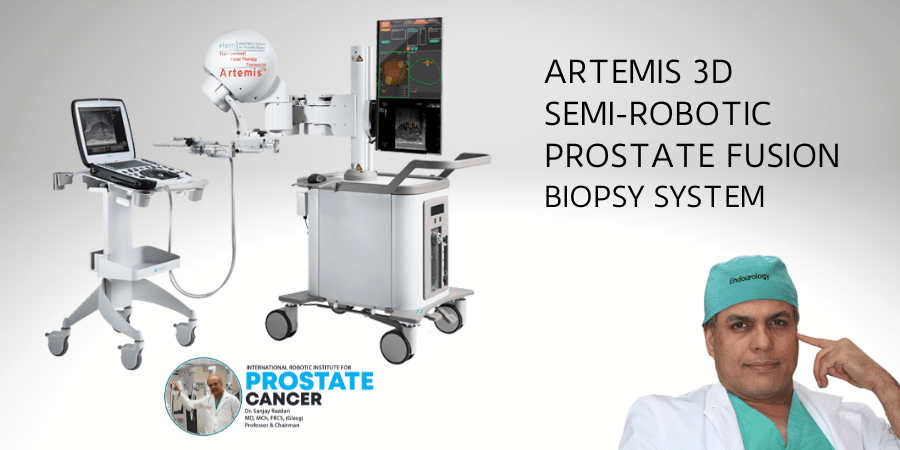
Miami, Florida, Oct 12, 2020 — International Robotic Institute for Prostate Cancer, a globally recognized state-of-the-art facility dedicated exclusively to prostate cancer treatment, today announced that it is the first center in South Florida to introduce ARTEMIS, a groundbreaking robotic solution for improving biopsy targeting in prostate cancer. The Artemis 3D Semi-Robotic Prostate Fusion Biopsy System is the latest innovation from Innomedicus. ARTEMIS is a pioneer and recognized leader in prostate image-guided fusion biopsy and targeted therapy with over 10 years of clinical expertise and persuasive published clinical results.
Fusion of mpMRI with real-time ultrasound images, together with semi-robotic, electronic-mechanical tracking of the organ and needles, results in clinical advantages not previously possible:
- significant improvement in the accuracy of prostate biopsy;
- precise needle navigation to identify lesions;
- exact reproduction of the treatment for analysis and re-biopsy.
Diagnosing prostate cancer can be a challenge, and conventional, systematic biopsies are often inconclusive, raising risks of missing high-grade tumors or under-staging lesions for active surveillance. Dr. Razdan utilizes the most Advanced Imaging and Computer-Assisted Detection Tool for Prostate Cancer, PROFUSE. This state-of-the-art software provides real-time analysis of mpMRI of the prostate, reporting of findings, and preparation of MRI data for fusion on the ARTEMIS biopsy system. Prostate Fusion Biopsy is a powerful advancement in diagnostic visualization that combines powerful real-time ultrasound imaging with data about lesion extent and location from MRI. By seamlessly fusing MRI information onto real-time ultrasound images without interruptions to workflow, this technology provides real-time guidance to help accurately and quickly target and biopsy lesions. MRI details from the radiology department can be easily imported into ARTEMIS via PACS, USB, CD, or a cloud platform, which enables secure and HIPAA-compliant data transfer.
“I am very pleased to be the very first in South Florida to offer ARTEMIS combined with recently FDA-approved Artificial Intelligence technology (AI) for our patients,” said Dr. Sanjay Razdan, Professor and Chairman of the International Robotic Institute for Prostate Cancer. “This is the solution that we in the urology community have been waiting for, made possible by combining Artemis’s expertise in medical image processing for assistance in cancer visualization with our strength in specialty ultrasound. Unlike current solutions for MRI-fusion, where the focus is on MRI, the ARTEMIS Fusion Biopsy System, combined with AI technology, has set a new standard in comprehensive prostate care.
“We are excited to partner with ARTEMIS to bring this innovation in urology to our patients,” Dr. Razdan says. Prostate Fusion Biopsy empowers MRI imaging in the urology office while delivering the patient-centered clinical benefits of targeted biopsy, all in the privacy and comfort of a convenient outpatient setting.
Dr. Sanjay Razdan is one of the Most Experienced Robotic Prostate Cancer Surgeons in the World with the BEST outcomes in terms of Cancer Control, Urinary Continence, and Erectile Function.
The International Robotic Institute for Prostate Cancer now offers patients the safest, most efficient, and accurate biopsy process available in all of South Florida. Guided by real-time MRI images combined with the world’s first FDA-approved Artificial Intelligence (AI), the results offer a significant degree of confidence and accuracy over traditional biopsy methods. Dr. Razdan is confident that MRI Ultrasound Fusion Guided Biopsy with Artificial Intelligence is a giant leap in the field of urology, helping urologists bring the most targeted and accurate biopsies into their practice.
Dr. Razdan has the distinction of being the 1st Urologic Oncologist in South Florida to employ AI in all of his MRI Fusion biopsies.
What are the two routes through which prostate biopsies can be performed?
There are various ways to perform the actual biopsy. Your healthcare professional will discuss the options with you and select the best approach for your particular condition. Biopsy options include –
- Transrectal Biopsy – Your healthcare professional removes the tissue sample through your rectum, the last part of your large intestine (the colon).
- Transperineal Biopsy – Your provider removes the tissue sample through your perineum, the area of skin between your anus and scrotum.
What is a multiparametric MRI-guided prostate biopsy?
Healthcare professionals also use MRI technology and needle biopsies to perform:
Multiparametric MRI (mpMRI) –Your healthcare provider compares results from a standard MRI to a newer MRI method. An mpMRI is highly sensitive and can identify cancerous areas better than a standard MRI. A prostate biopsy is still usually needed, as mpMRI cannot alone detect prostate cancer.
Fusion-guided prostate biopsy –This biopsy test is a combination of MRI and transrectal ultrasound (TRUS) technology. Here, the healthcare provider starts with an MRI to see any suspicion. During an actual biopsy, he combines MRI with ultrasound images with the help of advanced software and a prostate ultrasound probe. These images help providers precisely detect cancer and the tissues.
Benefits of Fusion Prostate Biopsy
MRI ultrasound fusion prostate biopsy combines highly detailed magnetic resonance imaging (MRI) images with ultrasound.
A fusion guided biopsy –
- Gives clear answers:With a prostate MRI biopsy, doctors can tell the difference between aggressive prostate cancers and slow-growing ones.
- Finds aggressive tumors: The test enhances a doctor’s ability to spot prostate tumors that need treatment.
- Helps prevent unnecessary procedures: With this targeted biopsy method, you can avoid treatment for slow-growing prostate tumors or repeat prostate biopsies.
To schedule your appointment or learn more about MRI Prostate Fusion Biopsy, call us at 305-251-8650.
Frequently Asked Questions
Question. What do the biopsy results mean?
Answer: Your biopsy results may be –
- Negative – There are no signs of cancer cells. It’s possible to get a false negative result. This means you have cancer even though the test indicates you don’t.
- Positive – Cancer cells are present, indicating prostate cancer. Your provider will discuss the next steps, such as treatment options or surveillance, with you.
- Suspicious – The results were abnormal and couldn’t exclude cancer. Your healthcare provider may order additional tests or another biopsy in a few months.
Question. Is MRI fusion biopsy painful?
Answer: Thanks to the use of local analgesia and blockade of the periprostatic nerve bundle, prostate fusion biopsy is not a painful procedure.
Question. How long does an MRI fusion biopsy take?
Answer: Most procedures are performed in two separate visits. The first visit requires an MRI of the prostate and takes approximately 45 minutes. This procedure does not require sedation. At the second visit, a transrectal ultrasound-fused biopsy is performed.