


 WhatsApp

For men undergoing robotic radical prostatectomy, preserving erectile function is one of the most critical survivorship milestones. Even when a high-volume robotic surgeon meticulously performs bilateral nerve-sparing surgery—dissecting the delicate neurovascular bundles (NVBs) off the prostatic capsule—neuropraxia frequently occurs. This temporary nerve stun is triggered by mechanical traction, thermal energy dissipation, local inflammation, and subsequent fibrous scar tissue formation that can compress recovering axons for months or even years.
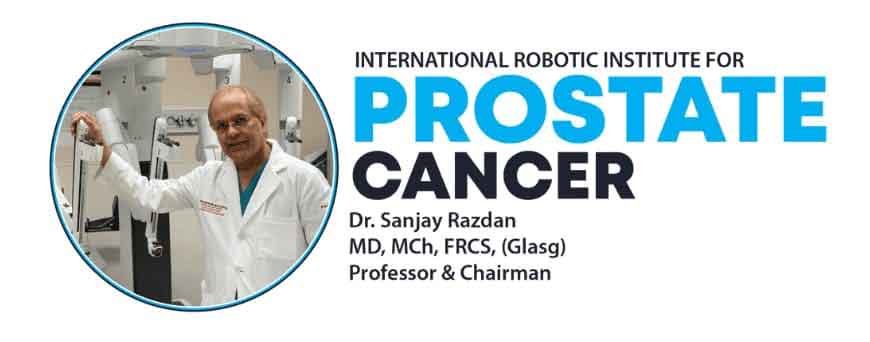
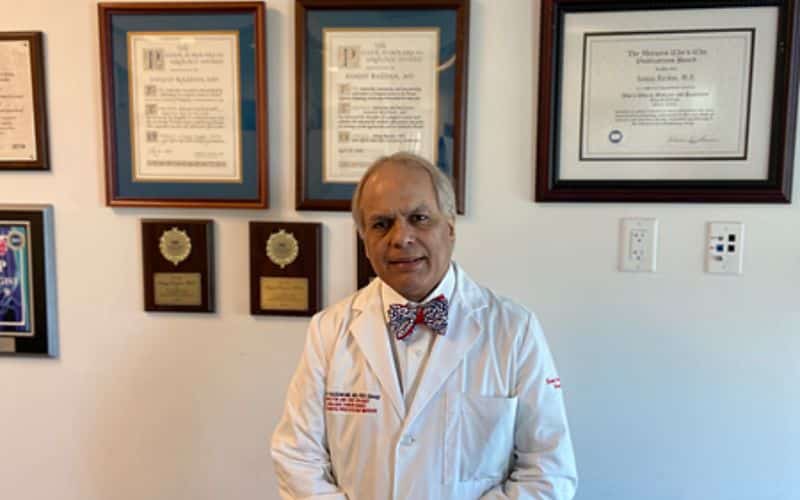
To overcome post-operative nerve stun and accelerate erectile recovery, world-renowned robotic urologic surgeon Dr. Sanjay Razdan pioneered the use of dehydrated human amniotic membrane (dHAM) allografts as a biological nerve wrap during robotic prostate cancer surgery.
Recognized globally for this innovation—winning First Prize for Original Research at the World Congress of Endourology—Dr. Razdan utilizes amniotic wraps at the International Robotic Institute for Prostate Cancer in South Florida. This technique provides a biological bridge that shields recovering nerves and significantly accelerates the return to sexual potency.
The Biology of Post-Surgical Nerve Stun (Neuropraxia)
The cavernous nerves responsible for triggering penile erections run along the lateral surfaces of the prostate gland in a microscopic, web-like mesh known as the neurovascular bundle.
[Meticulous Nerve-Sparing Dissection] ──► Traction / Surgical Manipulation
│
▼
[Deep Pelvic Inflammatory Cascade] ──► Cytokine release & localized edema
│
▼
[Perineural Fibrous Scarring] ──► Rigid adhesions compress & entrap axon fibers
│
▼
[Prolonged Erectile Dysfunction] ──► Recovery delayed 12 to 24+ months (without intervention)
Even without direct severing of the nerves, the inflammatory healing response in the pelvis forms rigid, collagen-dense scar tissue. When scar tissue tethers or constricts the neurovascular bundles, electrical conduction to the corpora cavernosa is impaired, leading to prolonged post-operative erectile dysfunction.
What is Human Amniotic Membrane?
Human amniotic membrane is an immune-privileged biological tissue obtained from the inner layer of the placenta during scheduled, healthy Cesarean births from thoroughly screened donors. It does not express HLA-A, -B, or -DR antigens, eliminating the risk of tissue rejection or graft-versus-host immune reactions.
Amniotic membrane allografts are naturally packed with essential regenerative components:
- Specialized Neurotrophic Growth Factors: Including Nerve Growth Factor (NGF), Fibroblast Growth Factor (bFGF), Epidermal Growth Factor (EGF), and Transforming Growth Factor-beta (TGF-$\beta$) that actively stimulate axonal sprouting and Schwann cell regeneration.
- Extracellular Matrix (ECM) Scaffolding: Rich in collagen types I, III, IV, and V, laminin, and fibronectin, providing a physical lattice along which damaged nerve sheaths can remodel.
- Anti-Inflammatory & Anti-Adhesive Cytokines: Interleukin-1 receptor antagonists (IL-1RA) and tissue inhibitors of metalloproteinases (TIMPs) that downregulate inflammatory cytokines and physically block collagen adhesion formation.
The Surgical Technique: How Dr. Razdan Applies the Amniotic Wrap
Dr. Razdan integrates the placement of the biological wrap immediately after completing the oncologic and reconstructive phases of the robotic procedure:
[da Vinci Robotic Prostate Excision] ──► Complete cold / athermal nerve-sparing dissection
│
▼
[dHAM Allograft Insertion] ──► Introduced via robotic trocar into the pelvic basin
│
▼
[Circumferential Nerve Wrapping] ──► Meticulously wrapped 360° around neurovascular bundles
│
▼
[Biological Shield & Healing Zone] ──► Rapid cytokine delivery, anti-scarring, and nerve healing
- Athermal, Traction-Free Dissection: Under 3D high-definition 10x robotic magnification, Dr. Razdan uses cold micro-dissection to release the neurovascular bundle cleanly from the prostatic capsule, avoiding thermal injury from cautery.
- Allograft Introduction: The dehydrated amniotic membrane sheet is hydrated and introduced directly into the pelvis through a robotic trocar.
- Circumferential Wrap: Using robotic micro-forceps, Dr. Razdan meticulously wraps the membrane sheets 360 degrees around both the left and right neurovascular bundles, anchoring them directly along the neural path.
- Natural Biological Barrier: The wrap acts as an immediate physical shield between the healing raw pelvic wall and the fragile nerves, preventing adjacent tissue planes from sticking to the nerve bundle. Over the subsequent weeks, the membrane releases healing factors before being naturally absorbed by the body.
Clinical Evidence: Peer-Reviewed Potency Outcomes
In a landmark matched and controlled longitudinal study published in the Journal of Robotic Surgery involving 1,400 patients (700 receiving the amniotic wrap vs. 700 matched controls), Dr. Razdan and his research team documented striking improvements in sexual recovery:
┌──► First Noticeable Erections: 34.6 Days (vs. standard delayed onset)
├──► 1-Year Potency Rate: 93.1% (vs. 87.1% in non-wrap control group)
[CLINICAL STUDY OUTCOMES]
├──► Likelihood of Potency Recovery: 3.86x Higher Odds Ratio (p < 0.001)
└──► Significantly Higher Sexual Health Inventory for Men (SHIM) Scores
- Significantly Earlier Return to Function: Patients who received the amniotic wrap experienced their first erection sufficient for intercourse at a mean of 34.6 days, compared to extended recovery windows seen with conventional surgery.
- Superior 1-Year Potency: By 12 months post-surgery, 93.1% of patients with the amniotic wrap achieved satisfactory penetrative intercourse, compared to 87.1% in the non-wrap control group.
- Zero Negative Impact on Cancer Control: Extensive oncologic follow-up confirmed that applying amniotic membrane allografts does not increase positive surgical margin rates or compromise post-operative PSA surveillance.
Conventional Nerve-Sparing vs. Dr. Razdan’s Amniotic Wrap Protocol
| Clinical Metric | Standard Nerve-Sparing Prostatectomy | Dr. Sanjay Razdan’s Amniotic Wrap Protocol |
| Neural Protection | Naked nerve bundles left exposed to pelvic bed | 360° biological wrap shielding neurovascular bundles |
| Inflammatory Response | Unregulated cytokine cascade & edema | Attenuated via natural anti-inflammatory IL-1RA proteins |
| Scarring & Adhesions | Frequent fibrous tethering to surrounding muscle | Amniotic physical barrier prevents scar entrapment |
| Median Time to Erection | 6 to 12+ months | Often within 4 to 12 weeks |
| 1-Year Potency Rate | 70% to 85% depending on age/baseline | 93.1% achieving functional penetrative potency |
| Oncologic Safety Profile | Baseline cancer margin control | 100% oncologically equivalent; verified margin safety |
Conclusion
Preserving erectile potency after prostate cancer surgery is no longer a matter of passive waiting. By combining high-definition robotic surgical precision with the regenerative power of human amniotic membrane wraps, Dr. Sanjay Razdan actively accelerates nerve healing, minimizes scar compression, and restores quality of life.
- Surgeon: Dr. Sanjay Razdan, MD, MCh, FRCS (Glasg)
- Academic Leadership: Professor and Chairman, International Robotic Institute for Prostate Cancer
- Official Website:miamiroboticprostatectomy.com
- Practice Location: 3650 NW 82nd Ave, Suite 501, Doral, FL 33166
- Direct Consultations: (305) 251-8650