


 WhatsApp

Nephrolithiasis—kidney stone disease—is one of the most agonizing and recurrent urological conditions, affecting roughly one in ten adults during their lifetime. While small stones may pass spontaneously through hydration and medical expulsive therapy, large, impacted, staghorn, or recurrent stones present serious risks of persistent obstruction, urosepsis, perinephric abscess, and irreversible loss of renal parenchyma.
Historically, complex renal calculi required open anatrophic nephrolithotomy—a highly invasive surgery demanding extensive renal parenchymal incision, substantial bleeding risks, and prolonged recovery.
Today, the convergence of high-power holmium and thulium fiber lasers, flexible digital endoscopes, and miniaturized percutaneous access has shifted stone management into a scarless, minimally invasive domain.
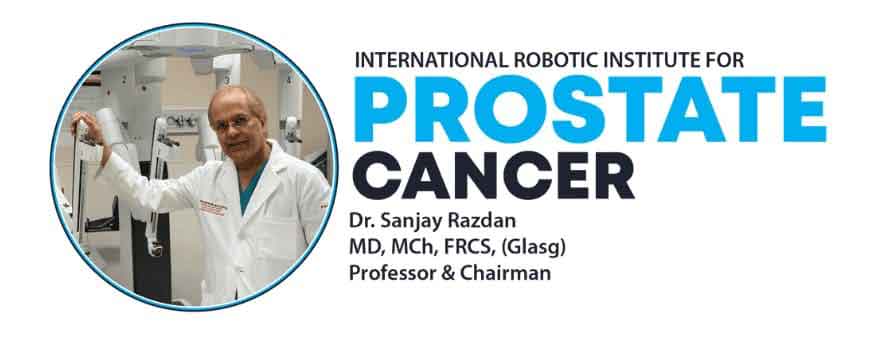
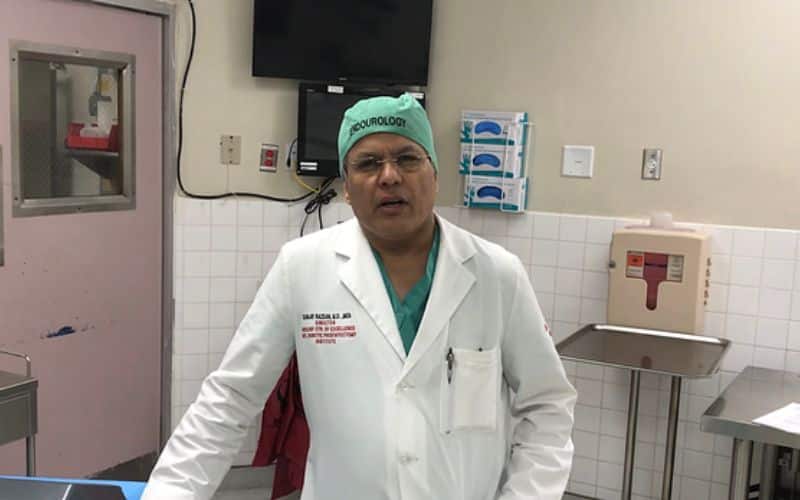
At the International Robotic Institute for Prostate Cancer and his specialized urology practice in South Florida, Dr. Sanjay Razdan applies decades of high-volume endourologic expertise to complex and recurrent stone disease. Utilizing advanced intracorporeal lithotripsy, micro-percutaneous nephrolithotomy (mini-PCNL), and comprehensive 24-hour metabolic stone risk profiling, Dr. Razdan delivers complete stone-free clearance alongside long-term recurrence prevention.
Endourologic Modalities for Stone Clearance: Stratified by Size and Anatomy
Surgical treatment selection depends strictly on stone size, location within the renal calyces, density (Hounsfield units on non-contrast CT), and infundibulopelvic anatomy:
┌──► 1. Extracorporeal Shock Wave Lithotripsy (ESWL)
│ ──► Non-invasive acoustic shockwaves; ideal for small (<1 cm) renal pelvic stones
│
[ENDOUROLOGIC SURGICAL SPECTRUM] ─┼──► 2. Retrograde Intrarenal Surgery (RIRS) / Flexible Ureteroscopy
│ ──► Natural orifice approach; high-power laser dusting for stones up to 2 cm
│
└──► 3. Percutaneous Nephrolithotomy (PCNL / Mini-PCNL)
──► Direct keyhole flank puncture; gold standard for complex/staghorn stones (>2 cm)
1. Retrograde Intrarenal Surgery (RIRS) & Laser Lithotripsy
For ureteral stones and intrarenal calculi measuring under 2 centimeters, Retrograde Intrarenal Surgery (RIRS) offers an incision-free pathway directly through the natural urinary tract.
[Transurethral Access via Ureter] ──► Flexible Digital Scope Navigation into Renal Calyces
│
▼
[Laser Energy: Holmium:YAG / TFL] ──► “Dusting” Mode (Micro-particles) vs. “Basketing” Mode (Extraction)
│
▼
[Complete Cavitary Inspection] ──► Near 100% stone clearance; temporary stent decompression
- Advanced Digital Deflection: Modern flexible ureteroscopes feature 270-degree bidirectional tip deflection and high-definition digital sensors, allowing direct visualization into challenging lower-pole calyces.
- Laser “Dusting” vs. “Fragmenting”:
- Dusting (High Frequency, Low Pulse Energy): Vaporizes dense calcium oxalate or cystine stones into micro-fine dust particles ($< 250\,\mu\text{m}$) that flush out naturally in the urine without colic.
- Popcorning / Basketing (Low Frequency, High Pulse Energy): Shatters hard stones into small fragments, which are then extracted using nitinol tipless wire baskets.
- Ureteral Access Sheaths (UAS): Placed in the ureter to facilitate repeated scope passage, reduce intrarenal fluid pressure, and prevent fluid absorption during prolonged laser firing.
2. Percutaneous Nephrolithotomy (PCNL) & Mini-PCNL for Massive Calculi
When stones exceed 2 centimeters, occupy multiple renal calyces (partial or complete staghorn calculi), or resist laser penetration, Percutaneous Nephrolithotomy (PCNL) remains the definitive standard of care.
[Target Calyx Fluoroscopic / US Puncture] ──► 0.5–1 cm Keyhole Dilatation in Flank
│
▼
[Rigid / Flexible Nephroscope Insertion] ──► Ultrasonic / Dual-Energy Ballistic Lithotripsy
│
▼
[Suction Evacuation of Mass Fragments] ──► Rapid, single-session clearance of staghorn stones
Mini-PCNL Advantages:
Traditional standard PCNL utilized large access tracts (24 to 30 French), which carried an increased risk of parenchymal bleeding and prolonged post-operative flank tube drainage.
Dr. Razdan utilizes Mini-PCNL instrumentation (12 to 18 French sheath sizes):
- Reduced Bleeding Risk: Smaller access tracts significantly decrease microvascular shearing across the renal cortex.
- Tubeless Pathways: Often allows for “tubeless” or “totally tubeless” closures, eliminating external nephrostomy drainage tubes and enabling 24-hour outpatient discharge.
- Exceptional Clearance: Ultrasonic and pneumatic lithotrites fragment and suction out massive stone volumes in a single session.
Comparative Overview: Treatment Selection Matrix
| Clinical Metric | Shock Wave Lithotripsy (ESWL) | Retrograde Intrarenal Surgery (RIRS) | Mini-PCNL / Standard PCNL |
| Optimal Stone Size | $< 1\text{ cm}$ | $1\text{ to }2\text{ cm}$ (or multi-calyceal) | $> 2\text{ cm}$ (Large, Complex, Staghorn) |
| Surgical Incision | None (External acoustic wave) | Zero (100% natural orifice transurethral) | Tiny flank puncture ($< 1\text{ cm}$) |
| Stone Clearance Rate | 65% to 75% | 88% to 95% single-session | 95% to 98% complete stone clearance |
| Lower Pole Stone Efficacy | Poor (steep infundibulopelvic angle) | High (with digital scope deflection) | Exceptional direct lower-pole target |
| Post-Operative Recovery | Immediate / same day | Outpatient; resume normal life in 1–2 days | 1 night hospital observation or outpatient |
| Anesthesia Type | Sedation / Twilight | General anesthesia | General anesthesia |
Recurrent Stone Disease: The 24-Hour Metabolic Evaluation
Surgically clearing a kidney stone addresses the acute structural problem, but without metabolic intervention, over 50% of stone formers develop a recurrence within 5 to 7 years.
Dr. Razdan pairs endourologic surgical clearance with an in-depth metabolic workup to identify and correct the biochemical drivers of stone crystallization:
[Recovered Stone Analysis via Infrared Spectroscopy]
│
▼
[Comprehensive 24-Hour Urine Metabolic Profile]
├─► Hypercalciuria (Excessive calcium excretion) ──► Thiazide Diuretics
├─► Hyperoxaluria (Dietary / gut absorption) ──► Dietary modifications & Calcium Citrate binders
├─► Hypocitraturia (Low citrate, natural inhibitor)─► Potassium Citrate supplementation
├─► Hyperuricosuria (Uric acid crystallization) ──► Allopurinol / Urine alkalinization (Target pH 6.5)
└─► Chronic Low Urine Volume ──► Targeted 2.5–3.0 L daily output
By pinpointing supersaturation levels of calcium oxalate, calcium phosphate, and uric acid, targeted medical therapy halts the cycle of chronic stone formation, protecting long-term renal function.
Conclusion
Suffering from complex or recurrent kidney stones does not require painful open surgery, recurrent ER visits, or persistent urinary tract infections. Through advanced laser dusting, flexible digital ureteroscopy, Mini-PCNL, and tailored metabolic prevention, Dr. Sanjay Razdan provides comprehensive endourologic solutions designed to achieve total stone-free status and permanent urinary health.
- Surgeon: Dr. Sanjay Razdan, MD, MCh, FRCS (Glasg)
- Academic Role: Professor and Chairman, International Robotic Institute for Prostate Cancer
- Official Website:miamiroboticprostatectomy.com
- Main Center Location: 3650 NW 82nd Ave, Suite 501, Doral, FL 33166
- Direct Consultations: (305) 251-8650