


 WhatsApp

For men diagnosed with localized prostate cancer, the decision to undergo radical prostatectomy often brings a dual burden of anxiety: eliminating the malignancy while safeguarding post-operative quality of life. Among surgical side effects, post-prostatectomy stress urinary incontinence (SUI) remains one of the most dreaded concerns. In traditional open and early robotic prostatectomies, prolonged pad dependency was common, often requiring 6 to 12 months for sphincter recovery.
In 2014, internationally renowned robotic urologic surgeon Dr. Sanjay Razdan pioneered the Maximal Urethral Length Preservation (MULP) technique. By fundamentally altering how the prostatic apex and membranous urethra are handled under high-definition robotic magnification, Dr. Razdan demonstrated that preserving the absolute maximum functional urethral length significantly accelerates early urinary control and addresses post-prostatectomy penile shortening.
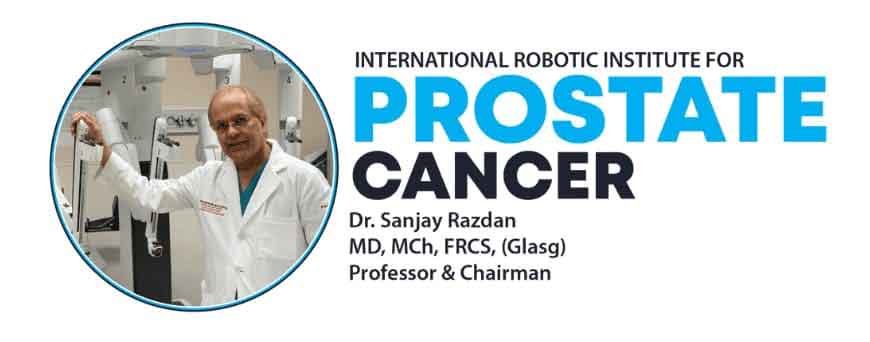
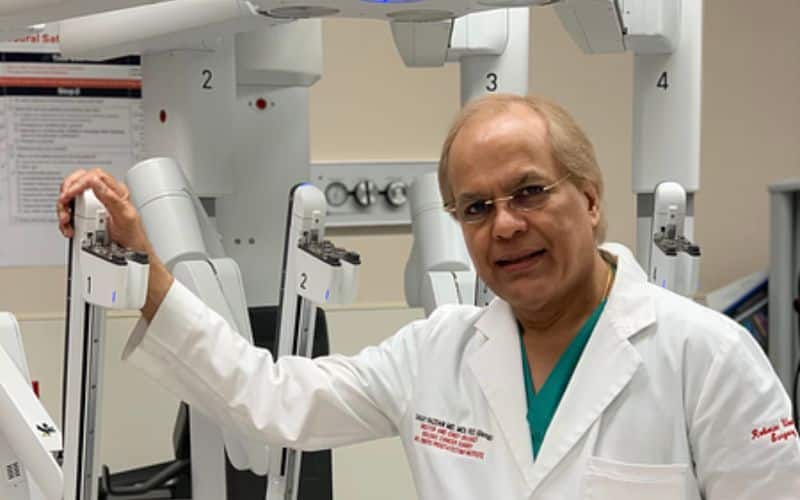
Practicing in South Florida as the Professor and Chairman of the International Robotic Institute for Prostate Cancer, Dr. Razdan has performed over 10,000 robotic procedures, utilizing MULP to help patients regain urinary control within days to weeks of surgery.
The Anatomical Challenge: The Sphincter Complex and Urethral Stump
The prostate gland sits immediately below the bladder base, encircling the upper urethra. Directly beneath the prostate apex lies the external urethral sphincter—the primary voluntary muscular valve responsible for continent urinary control.
[Normal Anatomy] ──► Bladder ──► Prostatic Urethra (encircled by prostate) ──► External Sphincter ──► Membranous Urethra
│
▼
[Standard Prostatectomy]──► Prostate removed ──► Urethra truncated close to sphincter ──► Anastomosis under tension
│
▼
[Dr. Razdan’s MULP] ──► Sub-millimeter retroapical dissection ──► Extra intraprostatic length saved ──► Tension-free closure
During a conventional prostatectomy, the urethra is transected near the apex to ensure clean oncologic margins and simplify apical visualization. However, this routinely shortens the functional membranous urethra. A shortened urethral stump reduces resting closure pressure and places excess downward traction on the bladder neck during reconnection (vesicourethral anastomosis), leading to delayed continence recovery.
How the MULP Technique Works
The MULP technique modifies the apical dissection phase through precise, high-magnification robotic micro-surgery:
[High-Magnification da Vinci Robotic Console]
│
▼
[Meticulous Retroapical Dissection] ──► Releases anterior & posterior apical attachments
│
▼
[Sub-Millimeter Urethral Unroofing] ──► Extends into the apical notch to preserve maximal urethral tube
│
▼
[Tension-Free Anastomosis] ──► Preserves intrinsic sphincter musculature and neurovascular supply
- Sub-Millimeter Retroapical Dissection: Utilizing 3D high-definition vision and robotic articulation, Dr. Razdan dissects the apical notch of the prostate from the urethral sphincter, avoiding blind cuts.
- Preserving Intraprostatic Urethral Segments: Rather than cutting squarely across the base of the apex, MULP carefully cores out additional millimeters of urethra embedded in the anterior and posterior apex, extending the functional length of the remaining stump.
- Minimizing Sphincter Trauma: The surrounding pelvic floor musculature, puboperinealis attachments, and delicate autonomic nerve branches supplying the rhabdosphincter remain untraumatized.
- Tension-Free Anastomosis: The preserved urethral length allows the reconstructed bladder-to-urethra junction to heal without mechanical stretch, maintaining proper anatomical alignment.
Primary Clinical Advantage: Accelerated Urinary Continence
Clinical data published in peer-reviewed journals, including the Journal of Endourology, demonstrates that preserving urethral length directly correlates with early continence recovery:
- Immediate Control: A substantial portion of patients experience complete, pad-free bladder control within days to weeks of having their temporary catheter removed.
- 3- to 6-Month Dry Rates: Over 96% to 99% of patients treated with the MULP protocol achieve full continence within 3 to 6 months post-surgery.
- Applicability Across All Risk Stages: While nerve-sparing protocols may be limited when cancer extends beyond the prostate capsule, MULP can be applied to nearly every patient, regardless of tumor stage or prostate volume.
Secondary Clinical Advantage: Preservation of Penile Length
Radical prostatectomy has historically been associated with post-operative penile shortening due to tissue retraction, scar contraction, and loss of structural support.
In a landmark prospective clinical study published in the Journal of Robotic Surgery, Dr. Razdan demonstrated that the MULP technique serves a vital structural role in protecting penile length:
- Structural Anchor: By retaining maximal urethral length, the urethra maintains its natural tissue tension, preventing excessive retraction of the cavernous bodies into the pelvis.
- Proven Clinical Outcomes: Over 80% of patients evaluated had zero decrease in stretched flaccid penile length (SFPL) post-operatively, making MULP an evidence-based surgical innovation that preserves both continence and physical anatomy.
Comparative Outcomes: Standard Technique vs. Dr. Razdan’s MULP Protocol
| Surgical Metric | Conventional Robotic Prostatectomy | Dr. Sanjay Razdan’s MULP Protocol |
| Urethral Dissection | Truncated at apex for surgical convenience | Meticulously unroofed for maximal functional length |
| Sphincter Disturbance | Frequent traction injury to muscle fibers | Protected via microscopic anatomical dissection |
| Median Time to Continence | 12 to 24+ weeks (extended pad use) | 3 to 4 weeks (frequently immediate/within days) |
| 6-Month Continence Rate | 80% to 88% complete dryness | 98% to 100% complete dryness |
| Impact on Penile Length | 60% to 100% experience measurable loss | > 80% experience zero loss of penile length |
| Anastomotic Tension | Moderate-to-high tension on suture line | Completely tension-free reconstruction |
Conclusion & Practice Information
Radical prostate cancer surgery does not have to result in long-term pad dependency or compromised anatomy. Through the Maximal Urethral Length Preservation (MULP) technique, Dr. Sanjay Razdan has advanced the field of robotic urology, providing men with cancer control alongside rapid recovery of continence and anatomical preservation.
- Surgeon: Dr. Sanjay Razdan, MD, MCh, FRCS (Glasg)
- Academic Role: Professor and Chairman, International Robotic Institute for Prostate Cancer
- Official Website:miamiroboticprostatectomy.com
- Main Center Location: 3650 NW 82nd Ave, Suite 501, Doral, FL 33166
- Contact Telephone: (305) 251-8650