


 WhatsApp


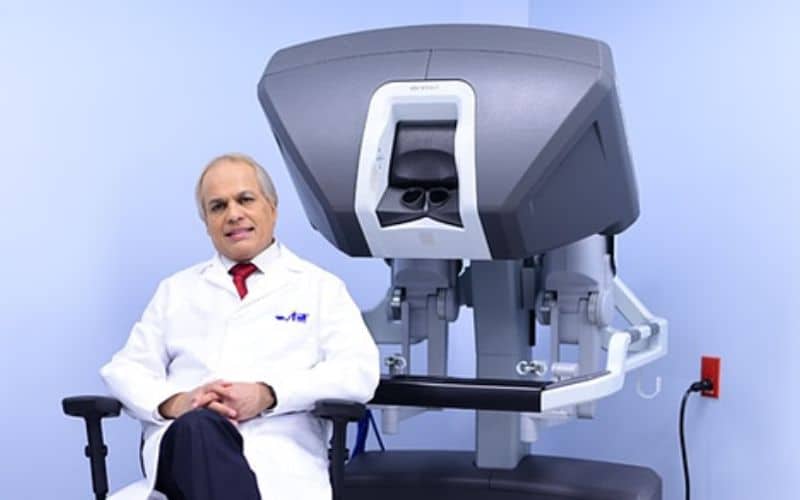
For men confronting localized prostate cancer, survivorship counseling traditionally focuses on cancer control, urinary continence, and erectile potency. However, an often under-discussed yet clinically prevalent side effect following radical prostatectomy is postoperative penile shortening. Studies show that between 60% and 100% of men experience measurable reductions in penile length after prostate cancer surgery, with losses ranging from 0.5 to over 2 centimeters.
This anatomical change frequently leads to substantial psychological distress, body-image dissatisfaction, and diminished sexual confidence. While many historical surgical protocols accepted shortening as an inevitable consequence of prostate excision, modern robotic innovations demonstrate that it is a preventable anatomical complication.
At the International Robotic Institute for Prostate Cancer in South Florida, world-renowned robotic surgeon Dr. Sanjay Razdan has performed more than 10,000 robotic procedures. Through rigorous prospective clinical research and proprietary apical dissection protocols—specifically the Maximal Urethral Length Preservation (MULP) technique—Dr. Razdan has established proven methods to protect penile length and preserve natural anatomy.
Etiology: Why Does Penile Shortening Occur After Prostatectomy?
Penile shortening is not caused by a single mechanism; it is the result of overlapping mechanical, structural, and physiological disruptions:
┌──► 1. Urethral Truncation & Downward Traction
│ (Vesicourethral anastomosis pulls external structures into pelvis)
│
[POST-SURGICAL SHORTENING AXIS] ──┼──► 2. Cavernous Nerve Stun & Prolonged Detumescence
│ (Loss of nocturnal erections leads to corporal hypoxia)
│
└──► 3. Corporal Fibrosis & Collagen Deposition
(Smooth muscle atrophy converts elastic tissue to rigid scar)
- Mechanical Retraction (The Urethral Pulley Effect): The prostate gland occupies 3 to 5 centimeters of space along the urinary axis. When the prostate is removed and the bladder neck is pulled down to reconnect with the severed urethral stump, excessive tension pulls the membranous urethra and the attached crura of the corpora cavernosa upward and inward into the pelvis.
- Prolonged Absence of Erections: Transient neuropraxia (nerve stun) after surgery stops the natural nocturnal tumescence cycles that supply oxygenated blood to the erectile tissue.
- Hypoxia-Induced Fibrosis: In a prolonged state of flaccidity, cavernous smooth muscle undergoes microvascular starvation. Elastic fibers are replaced by unyielding collagen, causing structural retraction and progressive atrophy of the penis.
Dr. Razdan’s Surgical Innovations for Length Preservation
To prevent the upward retraction of penile anatomy, Dr. Razdan employs refined surgical techniques that maintain structural tension and accelerate vascular recovery:
[1. MULP Technique] ──► Saves millimeters of extra functional urethra ──► Eliminates Anastomotic Tension
│
[2. Puboprostatic Ligament Care] ──► Preserves anterior suspensory balance ──► Prevents Structural Retraction
│
[3. Amniotic Membrane Wrap] ──► Accelerates cavernous nerve recovery ──► Restores Oxygenating Erections
1. Maximal Urethral Length Preservation (MULP)
Pioneered by Dr. Razdan, the MULP technique shifts the apical dissection into the sub-millimeter realm under 3D robotic magnification:
- Rather than amputating the urethra squarely across the apex of the prostate, MULP meticulously unroofs and cores out the intraprostatic urethra embedded in the anterior and posterior apical notch.
- This leaves the longest possible membranous urethral stump.
- The Mechanical Benefit: Because the urethral stump is significantly longer, the reconstructed vesicourethral anastomosis is completed under zero tension, preventing the external erectile bodies from being dragged into the pelvic cavity.
2. Preservation of the Puboperinealis and Suspensory Structures
Traditional prostatectomy often involves aggressive division of the puboprostatic ligaments and surrounding fascial planes. Dr. Razdan employs an anatomical approach that minimizes disruption to the suspensory apparatus of the penis, preserving the natural forward-projecting anchor of the shaft.
3. Amniotic Membrane Biological Shielding
By applying dehydrated human amniotic membrane (dHAM) wraps circumferentially around the neurovascular bundles, Dr. Razdan reduces local inflammation and delivers neurotrophic growth factors (NGF, bFGF). Published clinical data shows this accelerates the return of natural erections, re-oxygenating corporal smooth muscle early to prevent hypoxic atrophy and contracture.
Clinical Evidence: The Landmark Penile Length Study
In a landmark prospective clinical study authored by Dr. Razdan and published in the peer-reviewed Journal of Robotic Surgery, researchers evaluated stretched flaccid penile length (SFPL) before and after robotic prostatectomy using the MULP technique.
┌──► > 80% of patients experienced ZERO loss of penile length
[RAZDAN MULP CLINICAL DATA] ──┼──► Significant proportion gained measurable length post-op
└──► Independent predictor: Preserved urethral length = Preserved anatomy
- Zero Length Loss: More than 80% of patients undergoing robotic prostatectomy with Dr. Razdan’s technique experienced no loss in penile length at their postoperative evaluations.
- Documented Anatomical Gain: A subset of patients even exhibited an increase in measurable length, attributed to the complete relief of urinary obstruction and the complete absence of downward anastomotic tension.
- Direct Correlation: The study demonstrated a statistically significant correlation ($p < 0.001$): the greater the preserved functional urethral length at surgery, the greater the likelihood of 100% penile length preservation.
Comparing Outcomes: Standard Technique vs. Dr. Razdan’s Protocol
| Metric / Parameter | Conventional Robotic Prostatectomy | Dr. Sanjay Razdan’s Protocol |
| Urethral Dissection | Transected flush at the apex | MULP technique: Intraprostatic urethral unroofing |
| Anastomotic Tension | Moderate to high downward traction | 100% tension-free vesicourethral closure |
| Risk of Shortening | 60% to 100% experience 0.5–2 cm loss | < 20% experience minor changes; > 80% zero loss |
| Suspensory Support | Widespread division of anterior ligaments | Anatomical preservation of pelvic attachments |
| Nerve Rehabilitation | Standard passive recovery (12–24 mos.) | Amniotic membrane biological wrap for early potency |
| Continence Association | Delayed continence recovery | Synergistic: MULP accelerates early continence (~98%) |
Conclusion
Penile shortening should not be accepted as an unavoidable price of treating prostate cancer. Through the Maximal Urethral Length Preservation (MULP) technique and anatomical robotic micro-dissection, Dr. Sanjay Razdan provides patients worldwide with curative cancer outcomes while preserving both functional continence and baseline anatomical length.
- Surgeon: Dr. Sanjay Razdan, MD, MCh, FRCS (Glasg)
- Academic Role: Professor and Chairman, International Robotic Institute for Prostate Cancer
- Official Website:miamiroboticprostatectomy.com
- Main Center Location: 3650 NW 82nd Ave, Suite 501, Doral, FL 33166
- Direct Consultations: (305) 251-8650