


 WhatsApp

Hernias of the groin and abdominal wall—including inguinal, femoral, umbilical, and incisional hernias—occur when internal tissue or organs protrude through a structural weakness in the surrounding muscle or fascia. Left untreated, hernias do not heal spontaneously; they progressively enlarge, causing chronic discomfort, activity limitations, and the risk of acute strangulation or bowel obstruction.
While traditional open hernia repair required large, muscle-splitting incisions, modern minimally invasive surgery has shifted standard practice toward laparoscopic and robotic techniques. Both approaches access the preperitoneal space through small keyhole ports, avoiding large external wounds and facilitating faster return to physical activity. However, significant differences in surgical articulation, visual magnification, and tissue fixation separate the two platforms.
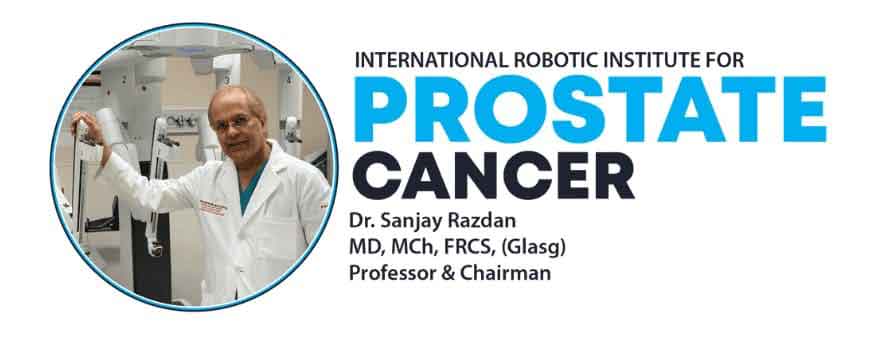
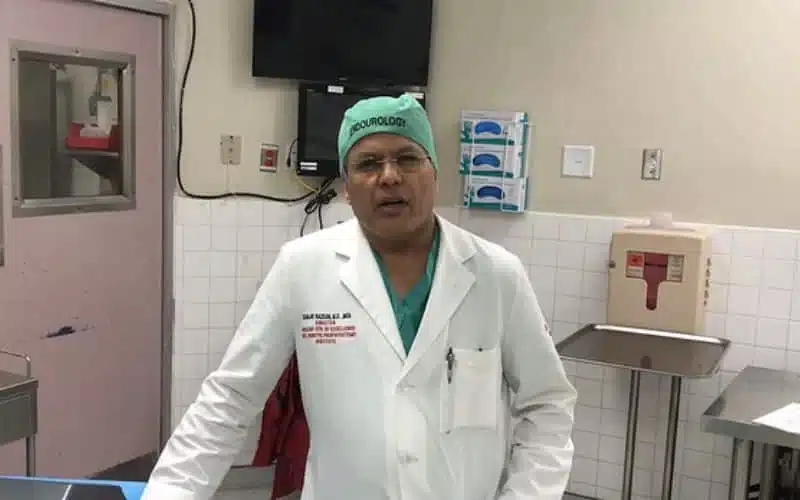
Practicing in Miami, Florida, Dr. Sanjay Razdan is a world-renowned urologic surgeon, Professor and Chairman of the International Robotic Institute for Prostate Cancer, and Director of Robotic Urology. With a surgical volume exceeding 10,000 robotic and complex pelvic procedures, Dr. Razdan frequently performs robotic inguinal hernia repairs concurrently with robotic prostatectomies, as well as standalone repairs for complex or recurrent hernias. Understanding the technical distinctions between robotic and standard laparoscopic hernia repair enables patients to select the approach best suited to their anatomy and recovery goals.
Understanding the Technologies: Rigid Laparoscopy vs. Articulated Robotics
The core differences between laparoscopic and robotic hernia surgery center on instrument mechanics, visualization, and surgeon ergonomics:
1. Conventional Laparoscopic Hernia Repair
Introduced in the 1990s, laparoscopic repair (commonly performed via Transabdominal Preperitoneal [TAPP] or Totally Extraperitoneal [TEP] approaches) relies on three small abdominal incisions:
- Rigid Instrumentation: The instruments are straight, rigid metal shafts with no wrist articulation. Movement relies on a “chopstick” effect pivoted at the abdominal wall, which limits maneuverability in deep or angulated pelvic corners.
- Two-Dimensional (2D) Optical View: The laparoscope projects a flat 2D image onto an external video monitor. Depth perception must be mentally reconstructed by the surgeon based on shadows and visual cues.
- Tack-Based Mesh Fixation: Because suturing with straight instruments inside a confined space is technically demanding, surgeons often secure the reinforcing mesh using mechanical metal or absorbable spiral tacks, which can increase the risk of nerve entrapment and chronic post-herniorrhaphy pain.
2. Robotic-Assisted Hernia Repair (da Vinci System)
Robotic hernia surgery represents an evolution of the laparoscopic concept, introducing multi-jointed instrumentation and stereoscopic vision:
- EndoWrist® Articulation: Robotic instruments feature micro-wrists that rotate and articulate with 7 degrees of freedom, mimicking and exceeding the natural dexterity of the human hand.
- Three-Dimensional (3D) High-Definition Magnification: The dual-optical console provides true stereoscopic depth perception with 10x to 15x magnification, allowing precise identification of the epigastric vessels, vas deferens, testicular vessels, and sensory nerve branches.
- Precision Suture Fixation (No Tacks): With full wrist articulation, the mesh and the peritoneal flap can be secured entirely with fine, running sutures rather than penetrating tacks. Eliminating aggressive tacks minimizes the risk of injuring sensory nerves in the “Triangle of Pain.”
Protecting the Anatomy: The Danger Zones of the Groin
Successful inguinal hernia surgery requires careful navigation around delicate anatomical boundaries:
- The Triangle of Doom: Defined by the vas deferens medially and the spermatic vessels laterally. Traversing this area are the external iliac artery and vein. Injury here causes severe hemorrhage.
- The Triangle of Pain: Located lateral to the spermatic vessels and inferior to the iliopubic tract. Within this boundary run the lateral femoral cutaneous nerve and the femoral branch of the genitofemoral nerve. Compressing or tacking these nerves can cause chronic, debilitating post-surgical groin pain.
Robotic surgery’s 3D magnification and wristed needle drivers allow the surgeon to reconstruct the defect and secure mesh precisely outside these danger zones, avoiding mechanical trauma to neural pathways.
Comparative Overview: Robotic vs. Laparoscopic Hernia Surgery
| Clinical Metric | Conventional Laparoscopic Repair | Robotic-Assisted Hernia Repair |
| Instrument Movement | Straight, rigid shafts (no wrist joints) | EndoWrist® with 7 degrees of freedom |
| Surgical Visualization | Flat 2-dimensional optical screen | True 3-dimensional stereoscopic 10x–15x view |
| Mesh Securing Method | Mechanical tacks (metallic/absorbable) | Microsuturing (Minimizes tack nerve entrapment) |
| Complex Defect Closure | Challenging; rarely closes large gaps | Direct sutured closure of primary fascial defect |
| Chronic Groin Pain Risk | Moderate (secondary to tack fixation) | Low (atraumatic anatomical suturing) |
| Bilateral Hernia Efficacy | Excellent (same 3 incisions) | Superior (clear visualization across midline) |
| Utility in Recurrent Cases | Difficult through dense scar tissue | Optimal for dissecting frozen, scarred planes |
Frequently Asked Questions (FAQ)
Can an inguinal hernia be repaired at the same time as a robotic prostatectomy?
Yes. Up to 15% to 20% of men diagnosed with prostate cancer have a coexisting inguinal hernia or an occult hernia defect discovered during surgery. Dr. Razdan routinely performs robotic hernia repair with mesh placement during the same operation, resolving both conditions under a single anesthesia without adding new incisions.
Why is robotic repair preferred for recurrent or complex hernias?
Recurrent hernias contain dense scar tissue from previous operations, obscuring normal tissue planes and embedding previous mesh. The multi-articulated wristed instruments and high-definition 3D visualization of the robotic console allow the surgeon to meticulously peel scar tissue away from the testicular vessels and nerves without inducing collateral trauma.
What is the typical recovery timeline following robotic hernia surgery?
Robotic hernia surgery is an outpatient procedure. Most patients return home within a few hours. Light walking is encouraged on the day of surgery, and most men resume sedentary work within 3 to 5 days. Full athletic conditioning, heavy lifting, and contact sports can typically be resumed after 2 to 4 weeks.
Conclusion
While conventional laparoscopic hernia repair provided a significant improvement over open surgery, robotic-assisted hernia surgery elevates precision, anatomical visualization, and nerve preservation. By eliminating the need for penetrating tacks, enabling direct fascial defect closure, and providing 3D stereoscopic clarity around pelvic danger zones, robotic repair minimizes recurrence and chronic discomfort. Consulting with an experienced robotic surgeon ensures an individualized approach tailored to the complexity of your hernia.
Schedule a Fast-Track Second Opinion with Dr. Sanjay Razdan
Whether evaluating robotic solutions for a primary or complex recurrent hernia, managing coexisting prostate conditions, or seeking a definitive opinion on treatment-resistant pelvic symptoms, surgical volume and technical mastery are paramount. With more than 10,000 robotic urologic and pelvic procedures performed, Dr. Sanjay Razdan provides thorough, personalized evaluations and fast-track clinical consultations for patients locally in South Florida, across the United States, and internationally.
- Expedited Consultations: Fast-track scheduling for in-person evaluations in Miami/Doral, alongside secure virtual record reviews for traveling patients.
- Advanced Reconstructive Expertise: Global leadership in robotic pelvic reconstruction, nerve-sparing prostatectomies, and complex salvage operations.
- Practice Location: International Robotic Prostatectomy Institute, 3650 NW 82nd Ave, Suite 501, Doral, FL 33166
- Direct Consultation Line: (305) 251-8650
- Online Consultation Portal: miamiroboticprostatectomy.com