


 WhatsApp

For men undergoing primary treatment for localized prostate cancer with external beam radiation therapy (EBRT), interstitial seed brachytherapy, or ablative modalities like High-Intensity Focused Ultrasound (HIFU) and cryotherapy, the expectation is long-term disease eradication. Unfortunately, a significant portion of patients eventually experience a biochemical recurrence—marked by a progressive rise in prostate-specific antigen (PSA) levels.
When localized cancer recurs or persists after energy-based treatments, options become limited. Historically, salvage surgery was avoided by many urologists due to high complication rates. Prior radiation and thermal ablation destroy natural tissue planes, creating severe fibrosis, devascularization, and scar tissue that welds the prostate to the rectum and bladder neck.
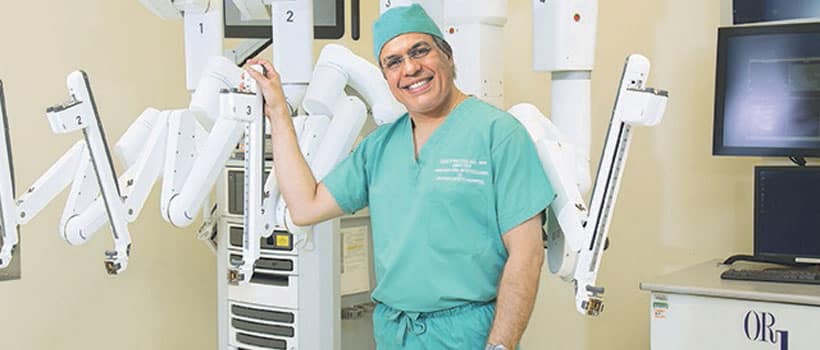
Today, Salvage Robotic-Assisted Radical Prostatectomy (sRARP) offers a viable curative option for carefully selected men with localized recurrence. As Professor and Chairman of the International Robotic Institute for Prostate Cancer in South Florida, Dr. Sanjay Razdan is one of the world’s most experienced robotic surgeons, having completed over 10,000 robotic procedures. With extensive experience in salvage robotic cases following radiation, brachytherapy, cryotherapy, and HIFU failures, Dr. Razdan employs refined micro-dissection techniques to excise recurrent cancer while preserving pelvic integrity and functional recovery.
The Hostile Surgical Field: Why Salvage Prostatectomy is Uniquely Complex
A primary robotic prostatectomy navigates virgin anatomy with defined tissue planes. In contrast, a salvage procedure requires re-operating within tissue that has undergone extensive thermal or radiation-induced alteration:
[Prior Radiation / Thermal Therapy]
│
▼
[Obliteration of Denonvilliers’ Fascia] ──► Prostate fuses directly to anterior rectal wall
│
▼
[Microvascular Endarteritis & Scarring] ──► Poor baseline blood flow and rigid, non-elastic tissue
│
▼
[High Clinical Risks (If Inexperienced)] ──► Rectal injury, severe incontinence, anastomotic leaks
- Loss of Denonvilliers’ Fascia: Radiation and focal heat dissolve the natural plane between the posterior prostate capsule and the anterior rectal wall, causing dense adhesions.
- Endarteritis Obliterans: Radiation damages micro-capillaries, depriving pelvic structures of oxygen and blood flow. This impaired microvasculature slows healing of the reconstructed bladder-urethral junction (anastomosis).
- Rigid Pelvic Floor: Fibrous scar tissue decreases bladder compliance and stiffens the external urethral sphincter, elevating the baseline risk of persistent post-operative stress urinary incontinence.
Recurrence Etiology: Radiation/Seeds vs. Post-HIFU Salvage
Not all salvage scenarios present the same technical hurdles. The prior treatment modality directly influences the degree of pelvic scarring:
[EBRT / Brachytherapy Seeds] ──► Diffuse, widespread pelvic scarring across bladder neck and rectum
VS.
[HIFU / Cryoablation] ──► Focal, localized tissue destruction; relatively preserved perimeter
- Post-Radiation / Seed Failures: Radiation delivers ionizing beams throughout the entire pelvic bowl, creating widespread scarring around the neurovascular bundles, bladder neck, and anterior rectum. Dissection requires sub-millimeter visual precision to avoid injury to neighboring pelvic structures.
- Post-HIFU Failures: Because HIFU applies targeted acoustic cavitation, tissue destruction is generally more confined. While the prostatic core may be fibrotic, peripheral tissue planes are often better preserved than in irradiated tissue, translating to an easier dissection, lower complication rates, and more favorable functional recovery.
Dr. Razdan’s Surgical Strategies in Salvage Robotic Cases
Managing recurrent malignancy in a previously treated pelvis requires advanced robotic techniques:
[Pre-Op 3D PSMA-PET/CT + MRI] ──► Confirm true localized recurrence (no distant metastasis)
│
▼
[Sub-Millimeter da Vinci Dissection] ──► Meticulous separation of prostate from anterior rectum
│
▼
[Maximal Urethral Preservation (MULP)] ──► Protects external sphincter to accelerate continence
│
▼
[Water-Tight Anastomosis Reconstruction] ──► Multi-layer tension-free vesicourethral closure
1. Cold Micro-Dissection Over Thermal Energy
Because irradiated tissue has compromised healing, Dr. Razdan relies heavily on sharp, cold robotic instruments rather than electrocautery near the rectum and external sphincter, preventing secondary thermal spread and tissue sloughing.
2. Tailored Nerve Preservation
While wide oncologic margins are prioritized to eradicate radiation-resistant cancer clones, nerve-sparing is pursued whenever preoperative imaging (such as mpMRI and PSMA PET/CT) indicates a clear plane away from the recurrent lesion.
3. Maximal Urethral Length Preservation (MULP)
Dr. Razdan integrates his proprietary MULP technique into salvage cases, unroofing and preserving every available millimeter of the membranous urethral stump to maximize post-operative urinary control.
4. Omental or Peritoneal Flap Interposition
To support healing and prevent fistula formation between the reconstructed urinary tract and the rectum, a vascularized flap of healthy tissue (such as omentum or peritoneum) can be placed as a protective biological shield.
Primary vs. Salvage Robotic Prostatectomy: Key Differences
| Surgical Parameter | Primary Robotic Radical Prostatectomy | Salvage Robotic Prostatectomy (sRARP) |
| Surgical Field | Pristine anatomical planes | Dense fibrosis, adhesions & scarred planes |
| Primary Indication | De novo localized prostate cancer | Biochemical recurrence after radiation, seeds, or HIFU |
| Rectal Injury Risk | Minimal (< 0.1% in expert hands) | Elevated; requires expert micro-dissection |
| Blood Loss & Invasiveness | Minimal; outpatient or 24-hr discharge | Low with robotics; significantly safer than open salvage |
| Catheterization Time | Typically 5 to 7 days | 7 to 14 days (ensures complete anastomotic seal) |
| Long-Term Oncologic Goal | Definitive initial cure | Second-chance curative eradication of local recurrence |
Patient Selection: Identifying the Right Candidates
Salvage robotic radical prostatectomy offers the highest chance of cure when strict clinical criteria are met:
- Documented Local Recurrence: Confirmed via prostate biopsy and multiparametric MRI.
- Absence of Distant Metastasis: Verified through advanced PSMA PET/CT imaging confirming no spread to distant lymph nodes or bones.
- Favorable Life Expectancy: Patients with good baseline physical performance status and a life expectancy of 10 years or greater.
- Manageable Pre-Salvage PSA Kinetics: Slower PSA doubling times typically indicate local rather than systemic recurrence.
Conclusion
A rising PSA level after radiation, brachytherapy, or HIFU does not mean your cancer is untreatable. While salvage prostate surgery is one of the most technically demanding operations in urology, modern robotic platforms and specialized surgical experience make complete cancer clearance and functional preservation achievable.
- Surgeon: Dr. Sanjay Razdan, MD, MCh, FRCS (Glasg)
- Academic Role: Professor and Chairman, International Robotic Institute for Prostate Cancer
- Official Website:miamiroboticprostatectomy.com
- Main Center Location: 3650 NW 82nd Ave, Suite 501, Doral, FL 33166
- Direct Consultations: (305) 251-8650